 InLoop Foam
Case study · Thermal management
Copper foam heat spreader keeps a processor at full speed
An industrial customer tested one of our printed copper foam spreaders on a processor running at full load. With water wicking through the foam, the processor never throttled. Dry, it held off throttling about six times longer than a bare chip.
- Throttling, evaporative
- None
- Full speed for all 30 minutes, peak 72.8 °C
- Time to throttle, dry
- 17.5 min
- vs 3 min with no spreader, about 6× longer
- Sustained speed, dry
- 91%
- vs 81% with no spreader, minutes 10 to 30
- Peak temperature drop
- 9 °C
- Evaporative vs no spreader, first 30 minutes
The part
One printed piece: solid base, open foam
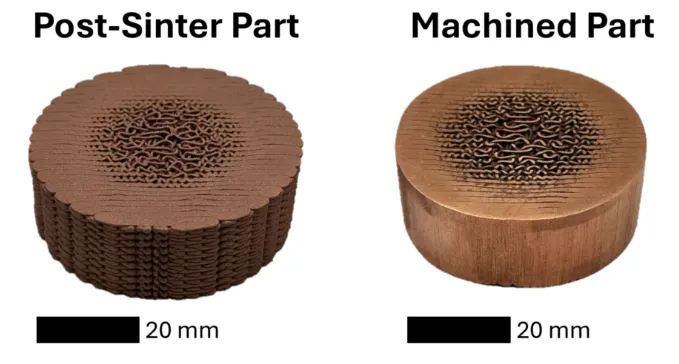
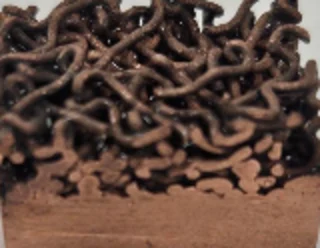
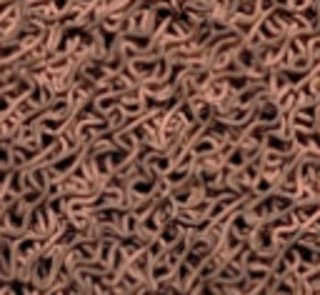
We printed the spreader by viscous thread printing in a copper composite and sintered it into a single copper part. It has two regions. A solid base, machined flat, sits on the processor. Above it, a low-density foam of coiled copper loops gives a large surface area and open paths for air or liquid.
Because the base and the foam are printed together, there is no braze or bonded joint between them for heat to cross. The loops grow straight out of the solid copper.
The test
Full processor load, three conditions
The customer ran a standard CPU benchmark at full load and logged processor temperature and performance every 30 seconds. Performance is the benchmark’s work rate as a share of its maximum; about 95% is this processor running unthrottled. Above 80 °C the processor slows itself down to protect the chip.
- No heat spreader. The bare processor package, for reference.
- Foam spreader, dry. No added fluid; the foam is cooled by the surrounding air.
- Foam spreader, evaporative. Water added around the foam, which wicks it up and evaporates it.
Results
Temperature and performance over 30 minutes
- Foam spreader, evaporative
- Foam spreader, dry
- No heat spreader
Time under full processor load (minutes)
View the data as a table
| Minute | Foam spreader, evaporative | Foam spreader, dry | No heat spreader |
|---|---|---|---|
| 1 | 55.6 °C · 95.2% | 58.0 °C · 93.9% | 72.8 °C · 95.3% |
| 2 | 60.5 °C · 95.2% | 63.1 °C · 95.1% | 78.8 °C · 95.2% |
| 3 | 64.7 °C · 95.0% | 65.7 °C · 95.2% | 80.4 °C · 91.4% |
| 4 | 66.2 °C · 95.0% | 68.6 °C · 95.0% | 79.9 °C · 86.8% |
| 5 | 67.2 °C · 95.0% | 71.3 °C · 95.0% | 80.4 °C · 84.9% |
| 6 | 68.2 °C · 95.3% | 71.7 °C · 95.2% | 80.8 °C · 83.8% |
| 7 | 69.2 °C · 95.0% | 72.8 °C · 95.1% | 81.4 °C · 83.1% |
| 8 | 69.2 °C · 95.1% | 73.3 °C · 94.4% | 80.8 °C · 82.4% |
| 9 | 69.8 °C · 95.1% | 74.9 °C · 95.0% | 80.4 °C · 82.1% |
| 10 | 70.7 °C · 95.1% | 74.9 °C · 95.0% | 80.4 °C · 82.0% |
| 11 | 71.2 °C · 95.2% | 76.3 °C · 95.1% | 80.4 °C · 81.3% |
| 12 | 72.3 °C · 95.0% | 76.3 °C · 95.0% | 81.9 °C · 80.9% |
| 13 | 70.7 °C · 95.1% | 76.3 °C · 94.8% | 81.4 °C · 81.1% |
| 14 | 70.7 °C · 95.1% | 77.9 °C · 95.0% | 81.9 °C · 81.0% |
| 15 | 70.7 °C · 95.0% | 78.3 °C · 94.7% | 80.4 °C · 81.3% |
| 16 | 71.2 °C · 95.0% | 79.9 °C · 93.7% | 81.4 °C · 81.1% |
| 17 | 71.2 °C · 95.0% | 79.9 °C · 92.8% | 79.4 °C · 81.4% |
| 18 | 70.7 °C · 95.0% | 78.3 °C · 91.0% | 80.8 °C · 80.8% |
| 19 | 71.2 °C · 95.1% | 79.9 °C · 91.6% | 79.9 °C · 80.6% |
| 20 | 72.8 °C · 95.0% | 79.4 °C · 91.1% | 80.8 °C · 81.1% |
| 21 | 71.7 °C · 95.0% | 80.4 °C · 90.3% | 80.8 °C · 81.4% |
| 22 | 71.7 °C · 95.0% | 79.9 °C · 89.4% | 81.4 °C · 81.3% |
| 23 | 71.7 °C · 95.0% | 78.8 °C · 89.4% | 79.4 °C · 80.7% |
| 24 | 71.2 °C · 95.0% | 79.9 °C · 88.7% | 80.4 °C · 80.8% |
| 25 | 70.7 °C · 95.0% | 79.4 °C · 88.5% | 80.8 °C · 80.6% |
| 26 | 70.7 °C · 95.1% | 79.4 °C · 88.3% | 80.8 °C · 80.4% |
| 27 | 72.3 °C · 95.1% | 79.4 °C · 88.8% | 79.9 °C · 80.5% |
| 28 | 71.7 °C · 95.0% | 79.9 °C · 88.8% | 80.4 °C · 80.5% |
| 29 | 71.7 °C · 95.1% | 79.4 °C · 88.1% | 80.4 °C · 80.5% |
| 30 | 70.7 °C · 95.0% | 79.9 °C · 88.8% | 79.9 °C · 80.1% |
What it shows
Why the foam helps
No spreader: the processor reached 80 °C within 3 minutes and settled near 81% performance.
Dry: the spreader’s copper mass and loop surface soaked up heat, so it took 17.5 minutes to reach 80 °C. Even then the processor held about 91%, because the loops shed heat better than the chip’s flat lid.
Evaporative: the processor peaked at 72.8 °C and never throttled. In a longer run it stayed below 80 °C at full speed for more than an hour.
An open reservoir is not how a product would be cooled. It is a fair stand-in for the vapor chambers and heat pipes in laptops and servers, which also move heat by evaporating fluid from a porous wick. Those wicks are usually sintered powder or mesh inside welded tubes. A printed foam could serve as the wick and the structure in one part, with the base machined to fit the chip.
Next steps we are exploring
- Surface treatments that make the copper loops wet more easily, for faster wicking
- Loop density and pore size tuned for airflow in fan-cooled designs
- Graded foam: fine pores near the chip, open channels toward the condenser or fins
Results are from one customer test of one part. We have withheld customer and device details. These values describe that test and are not a performance guarantee; see our terms of sale.
Send us a part to quote
Upload an STL for an instant budgetary estimate, or describe the problem and target properties and we will propose a structure. Reviewed quotes go out within two business days.
Prefer email? miske@foaminloops.com or brett@foaminloops.com