 InLoop Foam
Technology
Viscous thread printing
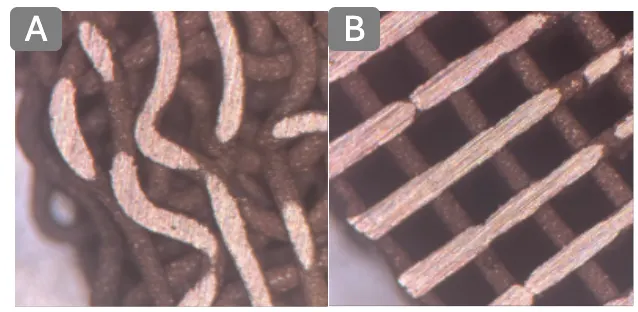
Viscous thread printing (VTP) builds foam the way honey coils on a spoon: a viscous thread buckles as it lands and loops into an open-cell lattice. We control that coiling with the toolpath, so every pore is placed on purpose.
How it works
Fluid-mechanical coiling, under control
When a viscous thread falls onto a moving surface it buckles into regular coils. The coil diameter and spacing depend on nozzle height, flow rate and travel speed. VTP turns those variables into design parameters: by changing them along the path, we change pore size and relative density continuously through a part.
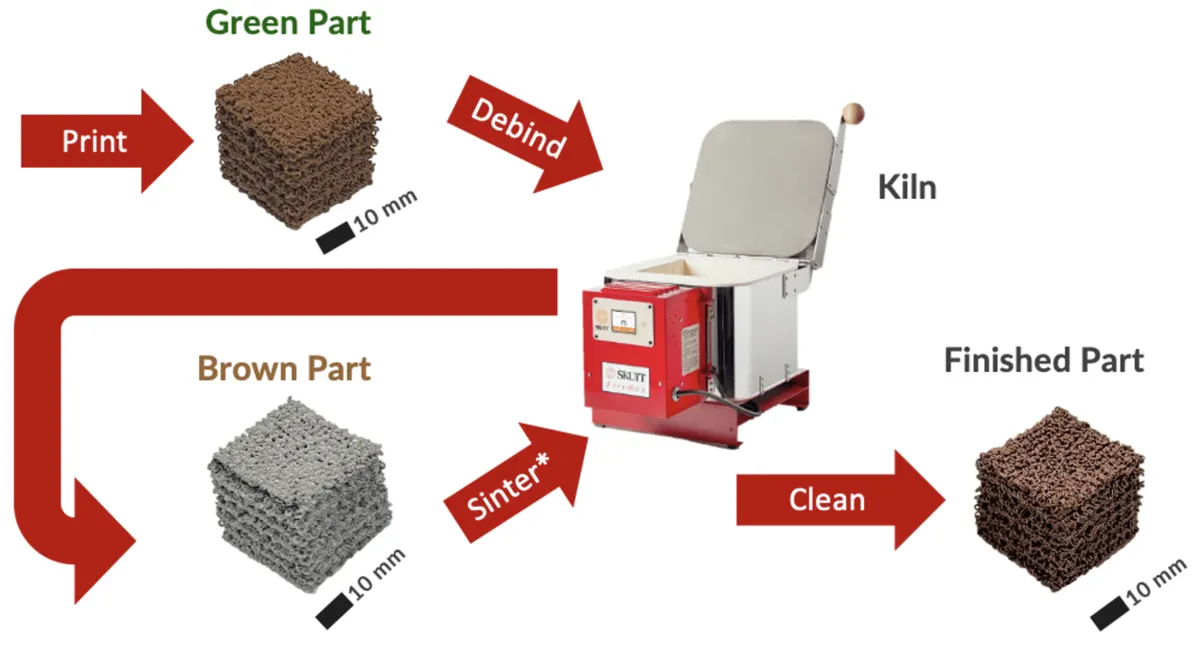
The printed thread can be a polymer, or a metal- or ceramic-loaded binder. Polymer foams are finished as printed. Metal and ceramic foams are debound and sintered into a fully bonded open-cell structure.
VTP was developed in the Transformative Robotics Lab at Northeastern University and has been featured on the cover of Advanced Science. The core method is patented; new process steps are patent pending.
Process
Print, sinter, verify
- 01
Print
A viscous composite thread is extruded along a continuous path and coils into an open-cell lattice. Pore size and strut thickness are set in the toolpath, not by a chemical blowing agent, so the structure repeats part to part.
- 02
Debind and sinter
For metal and ceramic foams, binder is removed and the green part is sintered to a full metallurgical bond. Shrinkage is characterized per material, so net-shape tolerances hold without secondary machining.
- 03
Finish and verify
Parts are cut, brazed or joined to your interface. We report density, pore distribution and compressive response for every build.
Comparison
VTP vs. conventional foam manufacturing
| Property | Viscous thread printing | Foamed or replicated |
|---|---|---|
| How porosity is set | Toolpath parameters | Blowing agent or template |
| Density gradients | Inside one part | Bonded layers, if at all |
| Outer geometry | Net shape | Blocks and sheets, then machined |
| Design iteration | File change, weeks | New tooling, months |
| Repeatability | Same path, same structure | Statistical distribution |

Research
Peer-reviewed foundations
The science behind VTP, including how coiling parameters set foam density and stiffness, has been published in peer-reviewed journals and featured on the cover of Advanced Science. InLoop Foam was founded to take that research into production.
About the teamSend us a part to quote
Upload an STL for an instant budgetary estimate, or describe the problem and target properties and we will propose a structure. Reviewed quotes go out within two business days.
Prefer email? miske@foaminloops.com or brett@foaminloops.com